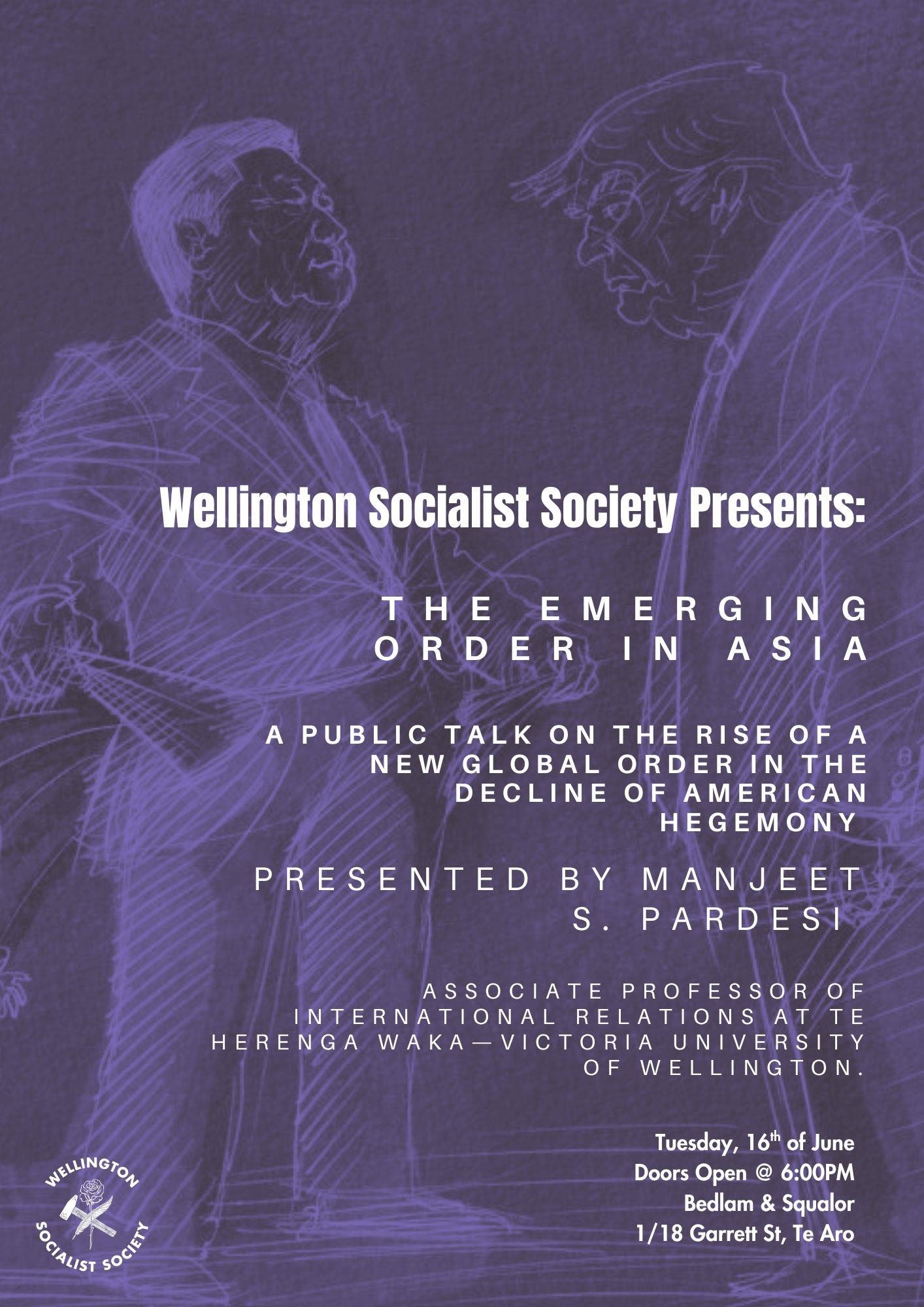
The passing of American hegemony is giving rise to a new kind of global order — one that is neither unipolar nor bipolar, and that goes beyond what is conventionally described as multipolarity.
This talk argues that we are entering a “multiplex” world: a multi-regional order in which regions play an increasingly important role, not merely as theaters of Great Power rivalry, but as relatively autonomous entities that shape the intensity and scope of that rivalry. These regions, moreover, are likely to remain open and interconnected with one another. The overriding purpose of such regional orders will be to prevent systemic breakdown rather than to project the dominance of any single power.
To illustrate this argument, the talk examines the emerging order in Asia (or the co-called Indo-Pacific) — the primary arena of US-China competition. Rather than consolidating around a new hegemon, this regional order is de-centered, non-hegemonic, and open. It is being shaped and legitimized not by the great powers alone, but by smaller and middle powers whose political systems and values are diverse. This Indo-Pacific order is also outward-looking, with growing connections to neighboring regions and beyond. Strikingly, this emerging order echoes a much older one. The “classical” Southeast Asian international system — in which the South China Sea and the eastern Indian Ocean were actively connected in the absence of any coercive or hegemonic power — offers a historical precedent for understanding what a post-American Indo-Pacific might look like.
Manjeet S. Pardesi is Associate Professor of International Relations in the Political Science and International Relations Programme and Asia Research Fellow at the Centre for Strategic Studies, Te Herenga Waka—Victoria University of Wellington. His research focuses on global orders and global history, great power politics, Asian security, and the Sino-Indian rivalry. His most recent book, Divergent Worlds: What the Ancient Mediterranean and Indian Ocean Can Tell Us About the Future of International Order (co-authored with Amitav Acharya, Yale University Press, 2025), received the 2026 T. V. Paul Book Prize from the International Studies Association, and a Chinese-language edition is forthcoming. He is also co-author of The Sino-Indian Rivalry: Implications for Global Order (with Sumit Ganguly and William R. Thompson, Cambridge University Press, 2023). From June 2018 to June 2025, he served as Managing Editor of the journal Asian Security. He received his PhD in Political Science from Indiana University, Bloomington. He holds an MSc in Strategic Studies from the Institute of Defence and Strategic Studies (now the S. Rajaratnam School of International Studies), Nanyang Technological University, Singapore, and a BEng in Electrical and Electronic Engineering from Nanyang Technological University.
——————————————————–
Event Proceedings:
6:00 pm – Doors Open
6:30 pm – Introductions
6:40 pm – Talk from Manjeet
7:20 pm – Intermission
7:30 pm – Audience Q&A
For those unable to attend we will have a live-stream on the Wellington Socialist Society Facebook page.
Drinks and food will be available to order from the bar. As always, we are thankful to Bedlam & Squalor for hosting us.
Starts On
June 16, 2026 - 6:00 pm
Ends On
9:00 pm
Event Categories